08.10.2026—01.11.2026
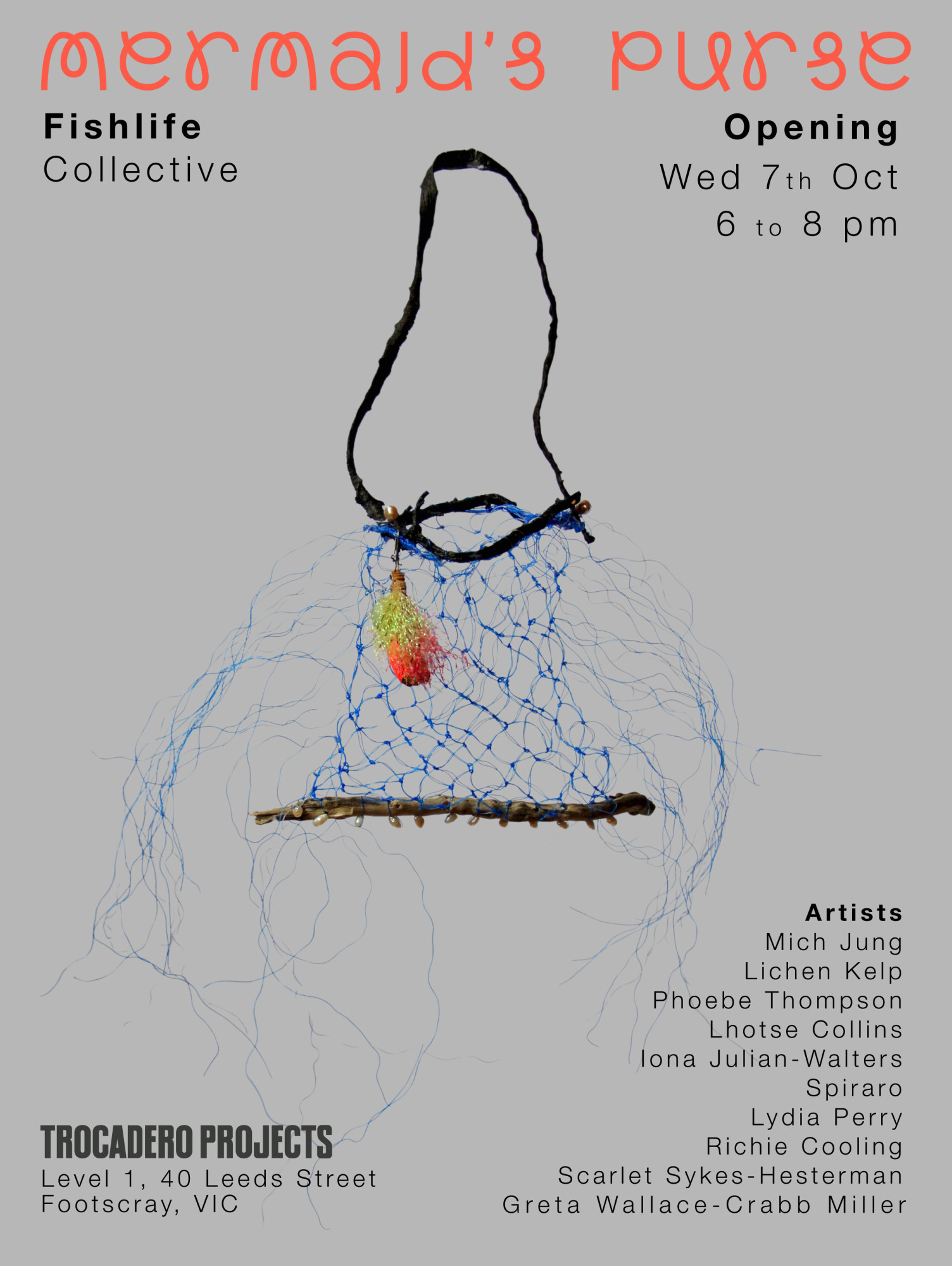
Exhibition Opening: Wednesday 7th October, 6–8pm Mermaid's Purse
Mermaid’s Purse is the first group show of FishLife Collective, bringing together the work of ten of FishLife’s artists and showcasing new work focussing on ocean ecologies and relationships.
“Mermaid’s purse” is the colloquial name given to the egg cases of sharks, rays, skates and chimeras - this object often found on everyday beach walks, hovers between myth and ecology; a potent encapsulation of the work of FishLife, whose collective focus is on ocean ecologies and how we can better understand these through creative practice and collaboration. This show, which covers textile, sculpture, installation and works on paper, looks at the potential of the artwork as a vessel for carrying forward our understanding of myth and ecology.
FishLife Collective was founded in 2024 by Naarm-based artists Iona Julian-Walters and Richard Cooling as an ocean ecologies project connecting artists and scientists through collaborative practice. Since then, they have hosted workshops and events across Australia. In 2026, FishLife joined Symbio Punk Library and the Seaweed Appreciation Society to create Floating Library, a community-owned ecology library. FishLife has grown to involving artists and scientists nationwide. Mermaid's Purse is FishLife Collective’s first group exhibition.
ABOUT THE ARTISTS
Mich Jing is an Asian multidisciplinary artist whose practice is fuelled by silliness, pranking and care, inspired by their Asian identity and more-than-human relationships. Riding an electric bike with their corgi Colbie, Mich explores relationships with their dog, shrimp family and the world around them. Their pranking practice creates temporary relationships, bringing surrealism, strange kindness and absurdity into everyday social structures. Their work has been presented at NGV Book Fair, MPavilion, Old Bar, Platform Arts, Black Spark Gallery and Udom Cafe.
Greta is an artist based on Wurunjeri country and Dharawal Country. Her art practice reflects relationships between human and seaweed, seaweed and star, star and milk crate. It is deeply practice-based, spanning across multiple-mediums and disciplines, their work is
concerned with materiality, methods-of-being and planetary ecologies. Such mediums include found-object assemblage, ceramics, bronze, mould-making, drawing and painting. Recently, she has explored chance-based-encounters with found objects to navigate the absurd material treatments in urban environments, and urban environments as human-habitat.
Lichen Kelp is an artist, performer and curator whose practice explores ephemeral biological processes and the transformation of chemical reactions. Through fieldwork, photography and live experiments, she investigates melting, flowering, decomposing, bubbling and shapeshifting within liquid landscapes. Her performances create multisensory environments combining sound, local botanicals, water, ice and handmade electronics. As a curator, she develops temporary, improvised communities around marine algae, estuarine ecologies, cuttlefish and plant cultivation, fostering collective approaches to ecological and multispecies research.
Based in Naarm/Melbourne, Australia, Richard Cooling’s practice explores human and non-human relationships to water and land. Working with recycled textiles, found materials, printmaking and digital design, he transforms functional objects for navigating sea and land into dysfunctional sculptures and prints that reframe our relationship to place. His work draws connections between natural and synthetic materials, such as kelp and neoprene or fish skin and tent fabric, while exploring craft, queer ecology and outdoor recreation.
Phoebe Thompson is a queer Irish-Australian artist, curator, poet and producer living on unceded Wurundjeri land. Their multidisciplinary practice explores ecology, sustainability, personal identity and human relationships with built and natural environments, emphasising slow, hand-formed processes, sentimentality and connection. They hold a Bachelor of Fine Arts from RMIT and have undertaken artist residencies in Portugal and Greater Dandenong. Their work has been exhibited and published widely, in collaboration with organisations including SIGNAL, Midsumma, City of Melbourne, RMIT and Bus Projects.
Scarlet Sykes Hesterman is a queer Naarm/Melbourne-based artist, educator and conservationist in training. Working across animation, drawing, video, installation and storytelling, Scarlet explores ecological connections between communities and the natural world. She graduated from RMIT’s Bachelor of Animation and Interactive Media in 2018 and has exhibited locally and internationally, including at the Melbourne International Film Festival, Library at the Docks and Dot.Space Gallery. Scarlet also facilitates school workshops focused on coastal ecology, illustration and creative engagement with nature.
Lhotse Collins is a multidisciplinary artist working across installation, performance, creative writing and public programs, with a focus on place-based anti-colonial research. Their practice explores water, myth, history, counter-archives and the otherwise. Lhotse grew up on Yuin Country by the sea and lives on Wurundjeri Country in Naarm. They are currently an Artist in Residence at the Living Museum of the West and studying to become a librarian. In 2025, they studied at Madrid’s Postnatural Institute and presented Becoming Wetland.
Iona Julian-Walters is a queer Naarm-based artist working across drawing, sculpture, photography, performance and installation. Her interdisciplinary practice explores ecology, bodies, relationships, fertility and death, often recontextualising discarded materials into new possibilities. Drawing sits at the centre of her practice and opens pathways to explore complex ideas of climate reality, grief and hope. Iona has exhibited nationally and internationally, in 2024 she was shortlisted for the Northern Beaches Art and Design Prize and presented her first solo exhibition, Eat or Be Eaten, in 2026.
Spiraro is a Naarm/Melbourne-based artist working across textiles, sculpture, biomaterials and lighting. Their multidisciplinary practice explores the material life of textiles through multisensory engagement, combining natural pigments, seaweed, bacterial leather, steel and discarded textiles. Blurring the boundaries between organic and human-made, their work considers how future materials might coexist with those of the past. Spiraro’s practice extends into curation and facilitation through Bio(me) and Biolab, creating opportunities for artists and communities to experiment with waste, biomaterials and sustainable material futures.
As a scientific researcher by trade, Lydia brings an analytical aspect into all her creations. Born and raised on the pristine beaches of Tasmania, her work is heavily influenced by the feeling of sand between toes, gumtrees whispering in the wind and the delicious pink of winter sunsets. Lydia has an Undergraduate Degree in biochemistry and is currently doing her Masters of Biomedical Research.